
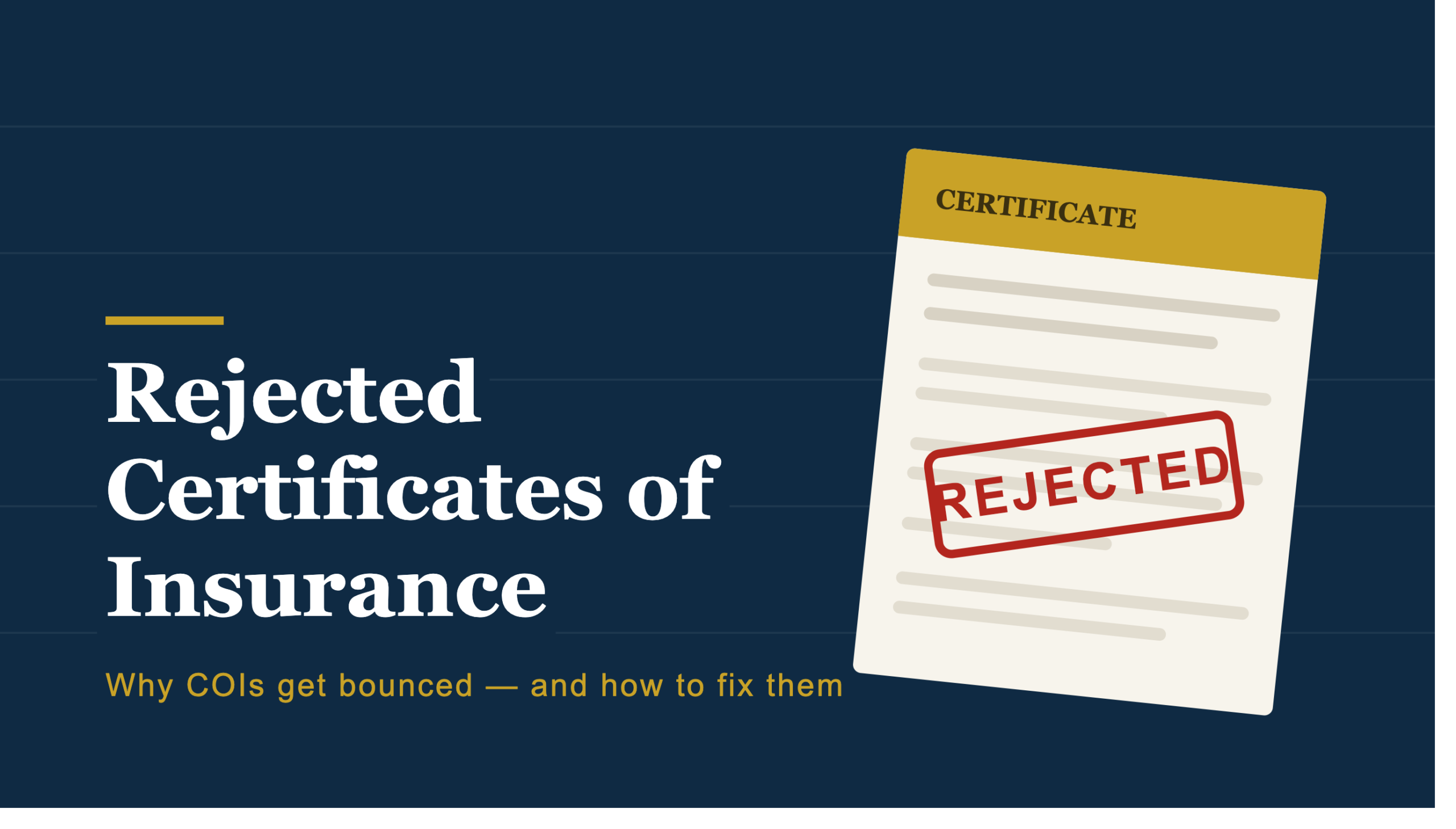
Why Your Certificate of Insurance Keeps Getting Rejected in Atlanta—and How to Fix It
Your insurance agent sends the certificate.
You forward it to the general contractor, property manager, landlord or event venue.
Ten minutes later, the reply arrives:
“Rejected. Certificate does not meet requirements.”
You look at the certificate again. Your company name is there. The policy numbers are there. The limits appear correct. The insurance carrier is listed. The policy has not expired.
So what exactly is wrong?
Here is the part many Atlanta business owners are never told:
A certificate of insurance is only evidence of the insurance that exists. It does not create coverage, add an insured, remove an exclusion or change the terms of your policy.
That distinction is the reason many certificates are rejected.
A contractor may have a valid $1 million general liability policy, but the project requires the property owner to be an additional insured. A restaurant may have liquor liability, but the landlord also requires primary and noncontributory wording. A janitorial company may have workers’ compensation, but the building manager wants a waiver of subrogation.
Those requirements are not automatically satisfied because someone typed them into the description box of an ACORD certificate.
Georgia law is particularly clear about this. A certificate provides a summary of coverage as it exists when the certificate is issued. It is not the policy, and it cannot be used to alter or expand the coverage. Georgia also prohibits certificates containing false or misleading information or language that tries to create rights not provided by the actual insurance contract.

A representative Atlanta COI problem
The following conversation is a fictional but realistic example based on issues Atlanta-area contractors and service companies regularly face.
Business owner: “I sent the general contractor my certificate three times. They keep rejecting it, but I have general liability insurance.”
Insurance advisor: “Your general liability policy is active. That is not the problem. They are asking for additional insured status, primary and noncontributory coverage, a waiver of subrogation and completed-operations coverage.”
Business owner: “Can’t you just write that in the description box?”
Insurance advisor: “Only when the policy and its endorsements support what is being shown. The certificate cannot create those protections by itself.”
Business owner: “So I have insurance, but I still may not meet the contract?”
Insurance advisor: “Correct. Buying insurance and satisfying a specific contract are related, but they are not always the same thing.”
What is It?
Your COI is a snapshot—not the coverage itself
The Georgia Office of Commissioner of Insurance and Safety Fire defines a certificate as evidence of property or casualty insurance. The certificate generally displays information such as:
- The named insured
- The insurance producer
- The insurance carriers
- Policy types
- Policy numbers
- Effective and expiration dates
- Coverage limits
- Certain checked indicators
- The certificate holder
- A description of the operation, project or location
But the actual coverage comes from the policy, including its forms, declarations, conditions, exclusions and endorsements.
Georgia law states that a certificate does not amend, extend or alter the referenced coverage. It also does not give the certificate holder rights beyond those expressly provided by the policy. (Justia)
ACORD gives similar guidance: a certificate is not an insurance policy and does not provide, endorse, amend, extend or alter the terms of the policies it references. (ACORD)
The insurance-document hierarchy
YOUR CONTRACT OR LEASE
Explains what the other party requires
                ↓
YOUR INSURANCE POLICY
Determines what coverage actually exists
                ↓
POLICY ENDORSEMENTS
Add, limit, clarify or change policy provisions
                ↓
CERTIFICATE OF INSURANCE
Reports information about the coverage above
The certificate is at the bottom of the chain. It cannot rewrite the documents above it.
The 12 most common reasons an Atlanta COI gets rejected
1. The legal business name does not match
The named insured on the certificate must correctly identify the business covered by the policy.
Problems occur when a business operates under several names:
- The corporation has one legal name.
- The customer knows the business by a trade name.
- The contract uses an abbreviated name.
- The insurance policy lists only one entity.
- A newly formed LLC is not yet on the policy.
- The owner signs the contract personally, but the policy covers the company.
For example, suppose the policy names Peachtree Commercial Cleaning LLC, but the contract was signed by Peachtree Building Services. The reviewer may need evidence that the trade name and legal entity are properly connected.
Do not solve that problem by casually adding an uncovered company to the certificate. First determine whether the entity is actually insured under the policy.
2. The certificate holder’s name or address is incorrect
The certificate holder box identifies the person or organization receiving evidence of insurance. A reviewer may reject the document because:
- The company name is incomplete.
- “LLC,” “Inc.” or another legal designation is missing.
- The property-management company is listed instead of the building owner.
- A lender clause is incomplete.
- The address is wrong.
- The contract requires multiple parties to be identified.
- A specific department or risk-management address is required.
Follow the written instructions exactly. Do not guess which affiliated company should appear.
3. The business is confusing “certificate holder” with “additional insured”
These are not the same thing.
A certificate holder receives the certificate as evidence of insurance.
An additional insured may receive some insured status under the policy, subject to the wording, conditions and limitations of the applicable endorsement.
Simply placing an organization’s name in the certificate holder box does not make it an additional insured. Checking an additional-insured indicator or adding words to the description section also does not create coverage that the policy lacks.
The policy or an endorsement must support the additional-insured status being represented. Georgia prohibits a certificate from appearing to substantiate coverage that does not exist.
Three commonly confused requirements
| Requirement | What it generally means | What normally supports it |
|---|---|---|
| Certificate holder | Receives evidence of insurance | Properly issued certificate |
| Additional insured | Receives certain insured status, subject to policy terms | Policy language or additional-insured endorsement |
| Waiver of subrogation | Limits certain recovery rights of the insurer, as provided by the endorsement | Waiver-of-subrogation endorsement |
Important: None of these automatically provides the other two.
4. The reviewer requested the actual endorsement
Some certificate reviewers will not accept a checked box or description alone. They want a copy of the endorsement supporting the requirement.
This is not unusual in Metro Atlanta.
A City of Atlanta license agreement, for example, requires the City to be shown as certificate holder, requires additional-insured protection on specified insurance and requires the licensee to submit an additional-insured endorsement. The agreement also addresses primary coverage and completed operations. That is one specific City agreement—not a universal Atlanta requirement—but it demonstrates why the certificate alone may not satisfy a contract reviewer. (AgLanta)
Georgia’s current certificate guidance permits an agent to provide copies of actual policy coverage forms or endorsements so a certificate holder can verify coverage.
5. Ongoing operations are shown, but completed operations are missing
This issue is especially important for:
- General contractors
- Roofers
- Electricians
- Plumbers
- HVAC contractors
- Remodelers
- Concrete contractors
- Fire-protection contractors
- Installation companies
Ongoing operations generally concern work while it is being performed.
Completed operations generally concern certain liabilities arising after the work has been completed.
A project owner may require both. An endorsement providing additional-insured status for ongoing work should not automatically be assumed to provide the requested completed-operations protection. The exact forms and policy wording must be reviewed.
This is one reason a contractor can finish a job, submit what appears to be a valid certificate and still fail the final compliance review.
6. Primary and noncontributory coverage is not supported
A contract may require the contractor’s insurance to respond on a primary basis before insurance carried by the additional insured, with the other insurance not contributing, subject to the actual endorsement language.
However, the words primary and noncontributory cannot simply be added to a Georgia certificate as a coverage promise when the underlying policy does not support them.
Georgia’s 2024 bulletin specifically identifies an unconditional statement that a policy “will be” primary and noncontributory as an example of improper certificate language when it purports to make a coverage determination. The proper solution is to review the relevant policy provision or endorsement—not use the certificate to manufacture the result.
7. The waiver of subrogation is missing
Subrogation generally refers to an insurer’s right, after paying a covered loss, to pursue a responsible party when permitted by the policy and law.
A waiver-of-subrogation endorsement may restrict that recovery right in favor of a designated or qualifying party, subject to its wording.
These requests frequently appear in construction, landlord, property-management and vendor contracts. Local public documents provide concrete examples:
- A Fulton County agreement required additional-insured status, primary and noncontributory treatment and waiver-of-subrogation provisions.
- A DeKalb County facility agreement required primary and noncontributory general liability, a waiver of subrogation and additional-insured status.
- Invest Atlanta procurement documents have required similar provisions for certain contractors and consultants. (Fulton County Government)
These examples do not mean every Atlanta contract has identical requirements. They show why contractors should review insurance requirements before signing or bidding.
8. The limits do not satisfy the contract
A business may be properly insured and still carry limits below the amount required by a lease or service agreement.
A common contractual structure is:
- $1 million each occurrence
- $2 million general aggregate
- $2 million products-completed operations aggregate
- $1 million commercial auto combined single limit
- Statutory workers’ compensation
- Specified employers-liability limits
- An additional umbrella or excess limit
Those are examples, not universal legal minimums.
A 2024 Invest Atlanta request for qualifications, for example, required $1 million per occurrence and a $2 million aggregate for general liability, along with specified coverage features and insurer qualifications. Other projects may require different limits. (Invest Atlanta)
Never assume that the limits used on your last project will satisfy the next project.
9. Commercial auto requirements are incomplete
A company may say, “We do not own any vehicles, so we do not need commercial auto insurance.”
But the contract may still require coverage for:
- Owned autos
- Hired autos
- Non-owned autos
- Any auto
- Scheduled vehicles
- Drivers using personal vehicles for company business
A janitorial company whose employees drive their own vehicles between customer locations can have a different exposure than a contractor that owns a fleet of vans.
The correct solution depends on the business’s actual operations, the policy and the contract—not merely whether vehicles are titled in the company’s name.
10. Workers’ compensation is missing
Georgia generally requires workers’ compensation coverage when an employer regularly employs three or more people, whether full-time or part-time. Corporate officers and LLC members are included in the count even when certain individuals elect to reject coverage for themselves. (State Board of Workers’ Compensation)
But the legal threshold is not the end of the discussion.
A contractor, landlord or project owner may contractually require workers’ compensation even when a smaller business would not otherwise be legally required to purchase it. Georgia’s WC-10 guidance expressly warns that a general or principal contractor may impose a contractual workers’ compensation requirement on a business with fewer than the statutory number of employees. (State Board of Workers’ Compensation)
Therefore:
“I am not legally required to carry workers’ compensation” does not necessarily mean “this customer must let me work without it.”
11. The umbrella or excess policy does not meet the requested structure
A contract may require a total limit greater than the underlying general liability or auto limit.
For example, a contractor with $1 million of general liability may be asked to provide $5 million total. The additional $4 million may need to come from an umbrella or excess-liability policy.
But several questions must be answered:
- Does the umbrella sit over all required underlying policies?
- Are the correct limits shown?
- Is the additional insured recognized as required?
- Does the umbrella provide the requested primary treatment?
- Are there exclusions in the umbrella that are broader than those in the underlying policy?
- Does the project require a true umbrella or is an excess policy acceptable?
Georgia’s certificate bulletin warns against using the certificate to make an unconditional declaration that umbrella liability is follow-form. The actual excess or umbrella policy controls.
12. The requested cancellation notice does not exist in the policy
Many contracts say the certificate must provide 30 days’ advance notice of cancellation.
The certificate cannot create that notice obligation.
Under Georgia law, a certificate holder has a legal right to cancellation, nonrenewal or material-change notice only when the holder is named in the policy or an endorsement and the policy or endorsement requires that notice. The timing and conditions are governed by the insurance contract, not by wording placed on the certificate. (Justia)
This is an important distinction. The standard certificate language generally indicates that notice will be delivered according to policy provisions. It is not an independent promise of a particular notice period.

The description box is not a magic coverage box
One of the most common attempted fixes is:
“Just type everything the customer wants in the description of operations.”
That can create serious problems.
Georgia’s 2024 guidance prohibits using the ACORD 25 description box to summarize policy language in a way that is inconsistent with the law. The box may identify a project and may reference policy provisions by exact title, form number and edition date, with copies attached. It cannot be used to certify contract compliance or to state coverage that the policy does not provide.
Improper requests can include asking the agent to write that:
- All contract requirements are satisfied
- There are no exclusions for a particular operation
- Subcontracted work is covered
- The umbrella follows form
- Every affiliated company is an additional insured
- Coverage will apply in a particular claim
- A contractual notice period is guaranteed
A certificate reports coverage. It should not be treated as an insurance opinion letter, legal opinion or claim determination.
Georgia also restricts the use of unapproved supplemental questionnaires, affidavits and third-party forms that effectively ask an agent to certify coverage outside an approved certificate. Actual policy forms, endorsements or binders can be used when appropriate to demonstrate what the policy provides.
Georgia’s rules apply to the requester, too
Georgia’s certificate rules do not apply only to agents and insurance companies.
They also apply to:
- Certificate holders
- Policyholders
- Certificate-monitoring companies
- Certificate-compliance companies
- Organizations requesting certificates
- Parties acting on behalf of certificate holders
The law applies to evidence of coverage involving property, operations or risks located in Georgia, regardless of where the requester, policyholder, producer or insurer is located. (GA R&R)
Violations can potentially result in regulatory action and civil penalties of up to $5,000 per violation.
This means an out-of-state compliance company reviewing insurance for an Atlanta project cannot avoid Georgia’s certificate rules simply because its office is located elsewhere.
A practical COI correction process
When a certificate is rejected, do not keep resending the same document. Use this process.
Step 1: Get the rejection in writing
Ask the reviewer to identify each deficiency separately.
A useful request is:
“Please send the complete insurance requirements and identify the specific certificate item, endorsement, limit or policy provision that is considered deficient.”
Avoid working from a message that merely says “insurance rejected.”
Step 2: Send the full contract requirement to your agent
Do not send only a screenshot of one sentence.
Provide:
- The complete insurance section
- Indemnification language
- Scope of work
- Project name
- Project address
- Contracting parties
- Required limits
- Required endorsements
- Required certificate-holder wording
- Deadline for compliance
Your agent needs to understand both the insurance request and the work being performed.
Step 3: Separate certificate corrections from policy changes
Some corrections require no policy modification:
- Correcting a certificate-holder address
- Adding a project number
- Correcting a typographical error
- Updating an expired certificate after renewal
- Correcting a location description
Other requests may require a policy endorsement, additional premium or underwriting approval:
- Adding an additional insured
- Adding completed-operations status
- Adding primary and noncontributory wording
- Adding a waiver of subrogation
- Increasing limits
- Adding hired and non-owned auto
- Adding umbrella or excess coverage
- Removing or changing an exclusion
- Adding a new operation, location or entity
Step 4: Obtain the supporting endorsements
Ask for the forms that support the contractual requirements.
The reviewer may need:
- Additional-insured endorsement
- Completed-operations endorsement
- Primary and noncontributory endorsement
- Waiver-of-subrogation endorsement
- Notice-of-cancellation endorsement
- Designated-project aggregate endorsement
- Commercial auto endorsement
- Relevant umbrella or excess forms
Do not assume that one endorsement handles everything.
Step 5: Compare the wording—not just the form names
Two endorsements with similar titles may not provide identical protection.
Check:
- Who qualifies
- What triggers coverage
- Which operations are included
- Whether completed work is included
- Whether the endorsement is scheduled or blanket
- Whether a written contract is required
- When that contract must be executed
- Whether coverage is limited to the contract’s required amount
- Whether exclusions restrict the intended work
Policy interpretation can be complicated. In a dispute involving major contractual obligations, obtain advice from qualified legal counsel in addition to reviewing the insurance with a licensed agent.
Step 6: Resubmit a clean compliance package
Submit the documents in a logical order:
- Corrected certificate
- Additional-insured endorsement
- Completed-operations endorsement
- Primary and noncontributory endorsement
- Waiver-of-subrogation endorsement
- Other requested forms
- Brief cover message identifying each corrected item
Infographic 3: The COI rescue packet
REJECTION NOTICE
      ↓
FULL CONTRACT REQUIREMENTS
      ↓
COVERAGE AND ENDORSEMENT REVIEW
      ↓
POLICY CHANGE, IF REQUIRED
      ↓
CORRECTED ACORD CERTIFICATE
      +
SUPPORTING ENDORSEMENTS
      ↓
WRITTEN CONFIRMATION OF ACCEPTANCE
Do not stop when the certificate is sent. Confirm that the recipient accepted it.
Atlanta COI pre-bid checklist
Use this before signing a lease, subcontract or service agreement.
Business information
- Exact legal business name
- All entities involved in the work identified
- Trade names disclosed
- Project name and address confirmed
- Scope of work accurately described
Coverage
- General liability limits meet the contract
- Products-completed operations are addressed
- Commercial auto requirements are addressed
- Hired and non-owned auto requirements are addressed
- Workers’ compensation requirements are addressed
- Employers-liability limits meet the contract
- Umbrella or excess limits meet the contract
- Professional, pollution, cyber or other specialized coverage is addressed where required
Endorsements
- Additional-insured requirement reviewed
- Ongoing-operations requirement reviewed
- Completed-operations requirement reviewed
- Primary and noncontributory requirement reviewed
- Waiver-of-subrogation requirement reviewed
- Cancellation-notice requirement reviewed
- Supporting endorsements obtained
Certificate submission
- Certificate holder listed exactly
- Certificate holder address is correct
- Policy numbers and dates are correct
- Limits are correct
- Project number is included where requested
- Description does not promise unsupported coverage
- Required endorsements are attached
- Final acceptance is received in writing
Frequently asked questions
Is a certificate holder automatically an additional insured?
No. A certificate holder receives evidence of insurance. Additional-insured status must come from the insurance policy or an endorsement and remains subject to that wording. The certificate itself cannot create the status. (Justia)
Why was my certificate rejected even though the additional-insured box was checked?
The reviewer may require the actual endorsement. The endorsement may also provide only ongoing-operations coverage when the contract requires ongoing and completed operations. Another possibility is that the party shown does not qualify under the endorsement’s terms.
Can my agent put the required contract language in the description box?
Only limited and accurate information should be placed there. Georgia prohibits language that attempts to alter coverage, certify contract compliance or make a coverage determination. Project-identifying information and accurate references to policy provisions may be appropriate.
Can the ACORD 101 attachment be used to add language that is not allowed on the ACORD 25?
No. Georgia’s current bulletin states that the ACORD 101 is a schedule to the ACORD 25 and cannot say more than the policy itself provides.
Does Georgia require every business to carry general liability insurance?
There is no single universal Georgia requirement forcing every type of business to purchase the same commercial general liability policy and limits. Requirements frequently arise from leases, customer contracts, licensing rules, financing arrangements and the nature of the operation.
Does Georgia require workers’ compensation?
Georgia generally requires it when an employer regularly employs three or more people, including regular part-time workers. Corporate officers and LLC members count toward the threshold even if some elect not to be covered personally. (State Board of Workers’ Compensation)
Can a general contractor require workers’ compensation when I have fewer than three employees?
Yes. Even when the state threshold does not require your company to purchase coverage, a general contractor or project owner may make workers’ compensation a contractual condition of the work. (State Board of Workers’ Compensation)
Can a certificate guarantee 30 days’ cancellation notice?
Not by itself. The right to notice and the timing of notice must be supported by the policy, an endorsement or applicable law. The certificate cannot independently create that obligation. (Justia)
How quickly can a rejected certificate be corrected?
A clerical correction can sometimes be handled quickly. A request requiring a new endorsement, higher limits, underwriting approval or a different insurance policy may take longer. The safest approach is to review insurance requirements before the contract is signed or before the project begins.
What should I do when the requested endorsement is unavailable?
Ask the agent to explain the limitation, then request written clarification from the contracting party. The reviewer may accept alternative wording, but neither the business nor its agent should claim that unavailable coverage exists.
Can an out-of-state company require an improper certificate for a Georgia project?
Georgia’s statute applies when the certificate concerns property, operations or risks located in Georgia, regardless of where the certificate holder or requester is located. (Justia)
Where can a Georgia certificate violation be reported?
The Georgia Office of Commissioner of Insurance and Safety Fire states that complaints may be submitted through its Consumer Portal.
Do not wait until the day before the job starts
The best time to discover an insurance requirement is before you sign the contract.
The worst time is when your crew is waiting at a jobsite in Buckhead, Midtown, Marietta, Decatur, Sandy Springs or Alpharetta and the project manager says no one can begin until the insurance is approved.
A rejected certificate does not always mean your business is uninsured. It means the documents submitted do not demonstrate compliance with the reviewer’s requirements.
Sometimes the answer is a corrected certificate.
Sometimes it is an endorsement.
Sometimes it is a higher limit or an umbrella policy.
Sometimes the contract is asking for something your current carrier will not provide.
The only safe way to know is to compare three things carefully:
- The contract
- The insurance policy and endorsements
- The certificate being issued
Your next step
The Dixon Agency helps Atlanta-area contractors, property owners, restaurants, professional firms and service businesses review insurance requirements before a certificate problem delays a job or threatens a contract.
Bring us:
- The insurance section of your contract or lease
- Your current certificate
- Your policy declarations
- Any rejection notice
- The required endorsement list
- Your project deadline
We will identify which issues are clerical, which require policy changes and which requirements may need clarification from the requesting party.
Request an Atlanta COI Compliance Review
Call Brent Dixon at (786) 804-2580
This article provides general insurance education. Coverage depends on the complete policy, endorsements, facts and applicable law. It is not legal advice and does not guarantee coverage in any particular claim.
Suggested Source
- Georgia Office of Commissioner of Insurance and Safety Fire, Bulletin 24-EX-4
- O.C.G.A. § 33-24-19.1
- Georgia Rules and Regulations, Subject 120-2-103
- ACORD Certificate of Insurance FAQs
- Georgia State Board of Workers’ Compensation employer guidance
- City of Atlanta, Invest Atlanta, Fulton County and DeKalb County insurance-requirement examples





5 Comments