
Non-Renewed in Georgia
By Brent Dixon, Licensed P&C Commercial Insurance Advisor
Got a non-renewal notice on your Georgia commercial or condo property? Here’s exactly what the law gives you, how the notice periods actually work (45 days commercial, 60 days residential, 75 days workers’ comp), and a week-by-week playbook to replace coverage — often through surplus lines — before your policy lapses.
There are two envelopes no Georgia property owner wants to open. The first is a renewal quote with a number that makes your stomach drop. The second is worse: a notice of non-renewal. It means your carrier isn’t offering you a number at all. They’re done.
I get the panicked version of this call constantly:
Owner: “My insurer just sent a non-renewal. My policy ends in a few weeks. My lender’s going to force-place coverage and my HOA board is going to lose it. What do I do?”
Me: “First — breathe. A non-renewal is not a cancellation. Your coverage doesn’t stop today. You have a defined window, and if we start moving now, we almost always land you somewhere. Let’s get to work.”
That’s the truth most owners don’t know when they open the envelope: a non-renewal notice is the starting gun, not the finish line. Georgia law hands you a specific runway, and how you use those days is the entire ballgame.
This is the companion to our condo master policy premium article — where premium increases are the slow bleed, non-renewal is the sudden stop. Here’s exactly how it works in Georgia and the week-by-week playbook to replace your coverage before the clock runs out.
First, know the difference: non-renewal vs. cancellation
People use these words interchangeably, and it costs them. They are not the same thing, and the legal protections are different.
- Cancellation happens during your policy term — the carrier ends coverage before the expiration date. In Georgia, once a policy has been in force more than 60 days, a carrier can only cancel for a short list of reasons: nonpayment of premium, fraud, a material change in the risk, or your violation of the policy’s terms (O.C.G.A. § 33-24-47; Georgia OCI Bulletin 24-EX-2).
- Non-renewal happens at the expiration date — the carrier honors the current term to the end but declines to offer a new one. This is the far more common scenario for commercial and association property right now, and it’s what this playbook is built around.
The good news about non-renewal: because your carrier has to run out the current term, you keep full coverage right up to the expiration date. Your job is to have replacement coverage bound and effective the very next day — no gap, no lapse, no force-placed lender policy.
How much time do you actually have? (The Georgia notice rules)
This is where owners get burned, because the notice period depends entirely on what kind of policy you have. Here are the real numbers under Georgia law.
| Policy type | Minimum non-renewal notice | Authority |
|---|---|---|
| Commercial property / casualty (in force 60+ days) | 45 days before the policy termination date | O.C.G.A. § 33-24-47 |
| Residential real property (homeowners, landlord, some association) | 60 days (raised from 30, eff. Jan. 1, 2026) | SB 35 / Act 277, amending O.C.G.A. § 33-24-46 |
| Workers’ compensation | 75 days before the termination date | O.C.G.A. § 33-24-47(f) |
| Surplus lines (E&S) policy | Often little to no statutory notice — the policy terms and continued market availability control | Georgia Surplus Lines Reg. 120-2-89 |
A few things every owner should internalize:
1. Commercial is 45 days, not 60. The headline-grabbing “60-day” change from Act 277 applies to homeowners and residential property. If you own a commercial building, a restaurant, a warehouse, or a contractor operation, your statutory floor for non-renewal notice is 45 days (O.C.G.A. § 33-24-47). Condo and HOA associations sit in a gray zone depending on how the policy is classified — which is exactly why you check your notice and call your broker on day one, not day 40.
2. The notice must tell you why. Georgia requires the non-renewal notice to state the reason in plain, specific language — clear enough that “a person of average intelligence can identify the basis for the insurer’s decision without further inquiry” (Georgia Rule 120-2-15). That reason is gold. It tells your new broker exactly what to fix or explain in the next submission.
3. If the carrier botches the notice, you get 30 extra days. If an insurer fails to give proper notice under § 33-24-47, you’re entitled to purchase up to 30 additional days of coverage at the same terms, as long as you tender the pro-rata premium on or before the termination date (O.C.G.A. § 33-24-47(c)). It’s a safety valve, not a strategy — but if a carrier misses a deadline, that window is yours.
4. You have 15 days to challenge it. If you believe the non-renewal violates the law (for example, a residential policy non-renewed solely over two-or-fewer non-fault claims in 36 months — a prohibited reason), you can request a review by the Insurance Commissioner within 15 days of receiving the notice (Georgia Rule 120-2-53; Bulletin 24-EX-2).
Why the “60-day” playbook title, then, if commercial is 45? Because 45 days of statutory notice is the floor, not the goal. The owners who come out of a non-renewal clean are the ones working a 60-day runway — starting before the notice even arrives, or the instant it does. If you wait for the legal minimum to start shopping, you’re already behind.
Why carriers are non-renewing Georgia property right now
Non-renewals aren’t personal, and they’re rarely about a single claim. They’re the market working through a hard cycle. In Georgia specifically:
- Georgia is one of the least profitable property insurance states in the country. When carriers pay out more than they take in, they don’t just raise rates — they shed the risks they no longer want. Non-renewal is how a carrier “rebalances the book.”
- Reinsurance costs remain elevated after a run of hurricanes and severe convective storms (hail, straight-line wind), and those costs push carriers to non-renew older, coastal, or higher-hazard property.
- Underwriting appetite shifted. A carrier that happily wrote 20-year-old mid-rise condos or frame-construction contractors five years ago may have simply exited that class. Your building didn’t get worse; the carrier’s appetite changed.
- Aging building stock and stale valuations. Roofs past year 15, no reserve study, a statement of values that hasn’t moved while construction costs jumped — any of these can tip an account from “renew” to “non-renew.”
The lesson: a non-renewal is a signal about the carrier’s appetite, not a verdict on your insurability. There is almost always a market for the risk — it’s just not this carrier anymore. Frequently, the new home is the surplus lines market.
Meet your likely new home: the surplus lines (E&S) market
If your property is older, has prior claims, sits in a tough class (condo/HOA, frame construction, coastal, prior water losses), or your admitted carrier just exited, your replacement coverage will often come from the excess & surplus lines (E&S) market — non-admitted carriers that specialize in risks the standard market won’t touch.
This is normal, not a downgrade. But you should understand how it works in Georgia:
- A broker must “diligently search” the admitted market first. Before placing you with a surplus lines carrier, a Georgia broker generally must document three declinations from admitted insurers and sign an affidavit of diligent effort (Regure — Georgia Surplus Lines Compliance). This protects you — it proves the standard market genuinely wouldn’t write the risk.
- There’s a 4% Georgia surplus lines premium tax on non-admitted placements (Regure). Budget for it; it’s a real line item.
- Surplus lines policies play by different renewal rules. They’re generally not subject to the same statutory non-renewal notice requirements as admitted policies. The state’s own guidance warns that a surplus lines carrier “might not” tell you it’s not renewing until close to expiration — so you stay in close contact with your broker as the term ends (Georgia Reg. 120-2-89).
- The FAIR Plan is the true last resort. If even the surplus market can’t place you, Georgia’s FAIR (Fair Access to Insurance Requirements) Plan exists for property that can’t get coverage anywhere else. Your non-renewal notice is required to mention your possible FAIR Plan eligibility (Georgia Rule 120-2-15). It’s bare-bones and pricey, but it prevents a true lapse.
The practical takeaway: you need a broker with real E&S access. If your current agent can only show you two admitted quotes and a shrug, you are not seeing the market that’s actually going to solve this.
The 60-day non-renewal playbook
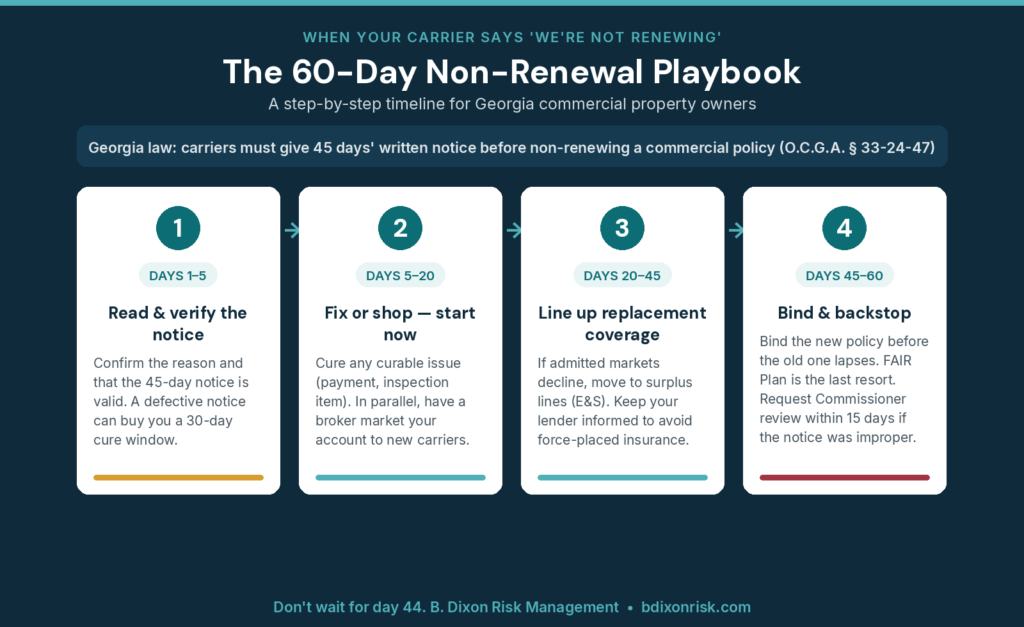
Here’s the exact process we run when a client hands us a non-renewal notice. Even if your notice already arrived, start wherever you are on this timeline and compress as needed.
Days 1–5: Read the notice and stop the clock panic
- Confirm the two dates that matter: the notice date and the policy termination (expiration) date. Your coverage is fully in force until that termination date. Write it on the wall.
- Read the stated reason. Georgia requires it. Is it the roof? Prior claims? A class exit? Valuation? This single sentence shapes your entire replacement strategy.
- Check whether the reason is even legal. For residential property, non-renewal solely for two-or-fewer non-fault claims in 36 months, or solely because of an underwriting-rule change not approved by the Commissioner, is prohibited (Bulletin 24-EX-2). If it looks improper, you have 15 days to request Commissioner review (Rule 120-2-53).
- Call a broker with E&S access — today. Not the week before expiration. Today.
Days 6–20: Build the replacement submission
The quality of your submission determines your options and your price. Assemble:
- Loss runs — 3–5 years of claims history from your current/prior carriers. New carriers ask first.
- The reason from your non-renewal notice — and your honest answer to it. If it’s the roof, get documentation of age, repairs, or a replacement plan. If it’s prior water losses, document the mitigation you’ve put in (leak sensors, repiping, updated valves).
- Updated statement of values / replacement cost — stale limits get penalized or declined.
- Reserve study and maintenance records (for condo/HOA) — carriers increasingly price as if these are mandatory even though Georgia doesn’t require them.
- Roof documentation — the single biggest property underwriting question in Georgia right now.
A clean, complete submission that directly answers the non-renewal reason is what turns a “decline” into a “quote.”
Days 21–40: Work the market — admitted, then E&S
- Your broker markets the admitted market first (required for the diligent-effort documentation, and admitted is usually your best terms if anyone will write it).
- Document the declinations. In Georgia, three admitted declinations open the door to surplus lines and satisfy the diligent-effort affidavit (Regure).
- Then work the E&S market, ideally through wholesale brokers who specialize in your property type. Ask for quotes structured multiple ways — different deductibles, with and without percentage wind/hail, layered limits for larger buildings. The spread between structures is often 20–40%.
- Ask about ordinance or law coverage if your building predates current codes — a major loss will be rebuilt to today’s code, and this fills that gap.
Days 41–55: Compare on total cost, not just premium
- Model premium + realistic deductible exposure + the 4% surplus lines tax for each option. The cheapest premium with a 5% wind/hail deductible can be the most expensive policy you ever buy.
- Confirm the new policy meets every contractual and lender requirement — loan covenants, HOA declaration minimums (condos need $1M/$2M liability under the Condominium Act), and any tenant-lease insurance clauses. A policy your lender rejects is not a solution.
- Verify effective date = the day after your current termination date. No gap. Ever.
Days 56–60: Bind, then communicate
- Bind the replacement coverage and get the binder/certificate in hand before the old policy expires.
- Send your lender an updated certificate immediately — this is what stops force-placed insurance.
- For associations, send owners a plain-English notice: the new carrier, the deductible, and what each owner needs on their HO-6 (including a recommended loss assessment limit). This one letter prevents most post-renewal disputes.
- File any required surplus lines paperwork through your broker (the diligent-effort affidavit and tax filing are handled on the broker side, but confirm it’s done).

What NOT to do when you get a non-renewal
- Don’t wait. The single biggest predictor of a bad outcome is starting late. Owners who start on day 40 get whatever’s left; owners who start on day 1 choose their carrier.
- Don’t let coverage lapse — even for a day. A lapse triggers lender force-placement (expensive and bare), makes you look worse to the next carrier, and can breach your loan or lease. Bind first, always.
- Don’t assume you’re uninsurable. A non-renewal is a carrier appetite decision. The surplus market exists precisely for the risks the standard market drops.
- Don’t shop it yourself with three different agents. Carriers see the same risk hit their desk from multiple agents (“submission churn”) and price defensively — or decline. Pick one broker with E&S depth and let them own the market relationship.
- Don’t ignore the stated reason. It’s the carrier telling you exactly what the next underwriter will ask. Answer it proactively in your submission.
Frequently asked questions
How long do I have after a commercial non-renewal notice in Georgia?
At least 45 days before the policy termination date for most commercial property/casualty policies in force more than 60 days (O.C.G.A. § 33-24-47). Residential property gets 60 days as of January 1, 2026 (Act 277), and workers’ comp requires 75 days. Check your specific notice — and start immediately regardless.
Is a non-renewal the same as a cancellation?
No. Cancellation ends coverage mid-term (allowed only for limited reasons after 60 days). Non-renewal lets your current term run to expiration but declines a new term. With a non-renewal, you stay covered until the expiration date — your job is to have replacement coverage effective the next day (Bulletin 24-EX-2).
Can I fight a non-renewal?
Sometimes. If you believe it violates Georgia law — for example, a residential policy non-renewed solely over two-or-fewer non-fault claims in 36 months — you can request a review by the Insurance Commissioner within 15 days of receiving the notice (Rule 120-2-53). For most commercial non-renewals, though, your energy is better spent replacing the coverage than contesting it.
What is surplus lines / E&S insurance, and is it safe?
It’s coverage from non-admitted carriers that specialize in risks the standard market declines. It’s legitimate and often the right answer for older buildings, tough classes, or prior claims. Georgia requires your broker to document three admitted-market declinations and file a diligent-effort affidavit before placing it, and a 4% state premium tax applies (Regure). Choose a broker with real E&S access.
What happens if I do nothing and my policy lapses?
Your lender will almost certainly force-place coverage — a bare-bones, expensive policy that protects the lender, not you — and bill you for it. A lapse also flags you to future carriers and can breach your loan or lease. The entire point of this playbook is to make sure a lapse never happens.
My carrier missed the notice deadline. What are my rights?
If the insurer failed to give proper notice under § 33-24-47, you may purchase up to 30 additional days of coverage at the same terms by tendering the pro-rata premium on or before the termination date (O.C.G.A. § 33-24-47(c)). Use it to finish placement — don’t rely on it as your plan.
Your next step
If a non-renewal notice just landed on your desk — or you suspect one is coming at your next renewal — the worst thing you can do is set it aside. The owners who come through this clean are the ones who start on day one.
The Dixon Agency specializes in hard-to-place and surplus lines property programs for Georgia commercial owners and condo/HOA associations. Bring us your non-renewal notice and your current declarations page, and we’ll build the replacement submission, work the admitted and E&S markets, and get you bound before your policy expires — no gap, no force-placement.
- → Request a free Non-Renewal Rescue Review
- → Download: Georgia Non-Renewal Response Checklist (PDF)
- → Or call Brent Dixon directly: (786) 804-2580
Brent Dixon is a licensed property & casualty commercial insurance advisor serving the Atlanta Metro area, specializing in condo/HOA associations, contractors, restaurants, and hard-to-place commercial risks.
Internal links (HOA / Condo & Commercial Property cluster)
- Why Atlanta Condo Master Policy Premiums Are Exploding in 2026 (the companion to this article)
- Wind/Hail Deductibles in Georgia: Why Your Lender Rejected Your Policy
- Reserve Studies and Insurance: Why Georgia Carriers Now Ask (SB 406 Arrives Jan 2027)
- HO-6 vs. Master Policy: What Atlanta Condo Owners Actually Need
- Why Your Certificate of Insurance Keeps Getting Rejected in Atlanta
Sources: O.C.G.A. § 33-24-47 (commercial termination/non-renewal notice; workers’ comp 75-day rule; 30-day cure for defective notice); O.C.G.A. § 33-24-46 as amended by 2025 Ga. SB 35 / Act 277 (residential 60-day notice, eff. 1/1/2026); Georgia OCI Bulletin 24-EX-2 (non-renewal requirements and prohibited reasons); Georgia Rules 120-2-15, 120-2-53, and 120-2-89 (notice content, Commissioner review, FAIR Plan eligibility, surplus lines); Georgia surplus lines diligent-effort and 4% premium tax requirements (Regure compliance summary)





3 Comments