The Coverage Gap Playbook: 7 Insurance Pitfalls That Sink Atlanta Restaurants & Clubs
Atlanta’s hospitality scene is one of the most dynamic in the Southeast. From the rooftop lounges of Buckhead to the late-night crowds of Edgewood Avenue and the packed patios of the Old Fourth Ward, the city runs on food, drink, and nightlife. But behind every full room is a risk profile that most owners underestimate — and that many insurance policies quietly fail to cover.
The uncomfortable truth is that a large share of Atlanta restaurants, bars, and clubs are carrying policies with gaps wide enough to end the business. Not because the owners were careless, but because hospitality insurance is genuinely complicated, the exclusions are buried, and the standard admitted markets have been retreating from this class of risk for years.
This playbook walks through the seven pitfalls that most often turn a claim into a catastrophe. If you own or operate a venue in metro Atlanta, treat this as a self-audit.

1. Assuming general liability covers liquor claims — it almost never does
This is the single most dangerous assumption in the hospitality business. A standard commercial general liability (CGL) policy contains a liquor liability exclusion. If you manufacture, sell, serve, or furnish alcohol, and a claim arises out of that activity, your CGL will not respond. You need a separate liquor liability policy.
Georgia’s dram shop law (O.C.G.A. § 51-1-40) makes this non-negotiable. The statute allows an injured third party to sue an establishment that knowingly served alcohol to a noticeably intoxicated person, or to anyone under 21, when that service proximately causes injury. A drunk-driving crash after last call can land squarely on your venue’s balance sheet.
Here’s the trap: many owners buy a package policy, see “liability” on the declarations page, and assume they’re covered. They’re not — unless liquor liability is a specifically scheduled coverage with its own limit. Verify it. Read the declarations. If the words “liquor liability” don’t appear with a dollar limit next to them, you have a hole.
2. Overlooking the assault & battery exclusion
If you run any kind of bar, lounge, or club — anywhere with a crowd, alcohol, and energy — this is the exclusion that keeps underwriters up at night, and it should keep you up too.
Most hospitality liability policies now contain an assault and battery (A&B) exclusion, or at minimum a heavily sublimited A&B endorsement. That means if a fight breaks out on your property, a patron is injured by a bouncer, or someone is hurt in a parking-lot altercation after leaving your venue, your policy may pay little or nothing.
A&B claims are among the most expensive in the entire hospitality sector. A single serious injury — a head trauma, a stabbing, a shooting — can generate a seven-figure demand. Plaintiffs’ attorneys in Georgia have grown sophisticated at framing these as negligent-security cases, arguing the venue failed to provide adequate lighting, cameras, trained security, or crowd control.
If your policy excludes A&B entirely, you are self-insuring one of your largest exposures. The fix is to negotiate an A&B coverage grant — often available through surplus lines carriers — with a meaningful limit, and to pair it with a documented security protocol that underwriters will actually credit. Because liquor liability and A&B are the two coverages owners most often get wrong, we break them down together in liquor liability vs. assault & battery for Atlanta nightlife.
3. Underinsuring property and, worse, business interruption
Owners obsess over liability and neglect the property side until a fire, a burst pipe, or a kitchen hood failure shuts them down. Two mistakes recur.
First, replacement cost is underestimated. Commercial kitchen equipment, walk-in coolers, custom build-outs, and specialized bar and sound systems cost far more to replace today than most owners insured them for three years ago. Construction and equipment inflation has been brutal. If your building limit and contents limit haven’t been re-evaluated recently, you are likely underinsured — and a coinsurance penalty could slash your payout even on a partial loss.
Second, and more devastating, is inadequate business interruption (BI) coverage. If a fire closes your restaurant for four months, BI is supposed to replace the income you would have earned and cover ongoing expenses like rent and payroll. But BI limits are frequently set too low, and the restoration period is often underestimated. Rebuilding a commercial kitchen and passing re-inspection can take far longer than owners expect. Confirm your BI limit reflects your actual trailing revenue, and that the indemnity period is long enough to survive a full rebuild.
4. Misclassifying workers and mishandling workers’ compensation
Georgia requires workers’ compensation coverage for any business with three or more employees, including part-time staff — and hospitality runs on part-timers. This is a compliance line item owners get wrong constantly.
Two failure modes dominate. The first is simply not carrying coverage because the owner miscounts, treating part-time servers, hosts, and kitchen help as if they don’t count toward the threshold. They do. Operating without required coverage exposes you to state penalties and to paying claims out of pocket.
The second is misclassification — labeling employees as independent contractors to reduce premium, or listing kitchen staff under a lower-rated clerical code. This isn’t just risky at audit time; it’s a form of premium fraud that can void coverage and trigger back-premium bills that arrive all at once. Classify honestly, and let the premium reflect reality. An audit-time surprise is always worse than an accurate policy up front.
5. Confusing host liquor coverage with a real liquor liability policy
This one snares venues that don’t think of themselves as “bars.” A private event space, a café that offers wine at a book launch, a restaurant that hosts a company holiday party — owners often assume the small amount of alcohol involved is covered under a “host liquor” provision.
Host liquor liability is narrow. It’s designed for businesses whose operations don’t include selling alcohol, covering incidental service where no charge is made and alcohol isn’t a regular part of the business. The moment you sell drinks, build alcohol into your revenue model, or serve regularly, host liquor coverage stops applying — and you need full liquor liability.
The gray zone catches a lot of Atlanta venues: the coffee shop that added a beer-and-wine license, the gallery that started charging for cocktails at openings, the restaurant that quietly grew its bar into a profit center. If your alcohol operation has evolved, your coverage needs to evolve with it. Don’t let a host-liquor endorsement lull you into thinking a growing bar program is protected.
6. Ignoring employment practices liability
The exposure owners least expect is the one that comes from their own team. Employment practices liability (EPL) covers claims of wrongful termination, discrimination, harassment, and retaliation. The restaurant and nightlife industry — with its high turnover, young workforce, late hours, and alcohol-adjacent environment — is statistically one of the most EPL-prone sectors there is.
A single harassment or wrongful-termination suit can cost tens of thousands to defend even if you did nothing wrong, and far more if you settle. Yet EPL is routinely left off hospitality programs because it isn’t part of the standard package and nobody flagged it. Georgia’s at-will employment framework helps on the margins, but it does not immunize you from federal discrimination and harassment claims under Title VII, the ADA, or the ADEA.
If you have more than a handful of employees, EPL coverage — often available as a standalone policy or a management-liability add-on — belongs in your program. Pair it with a written employee handbook, documented HR procedures, and manager training, all of which improve both your defensibility and your insurability.
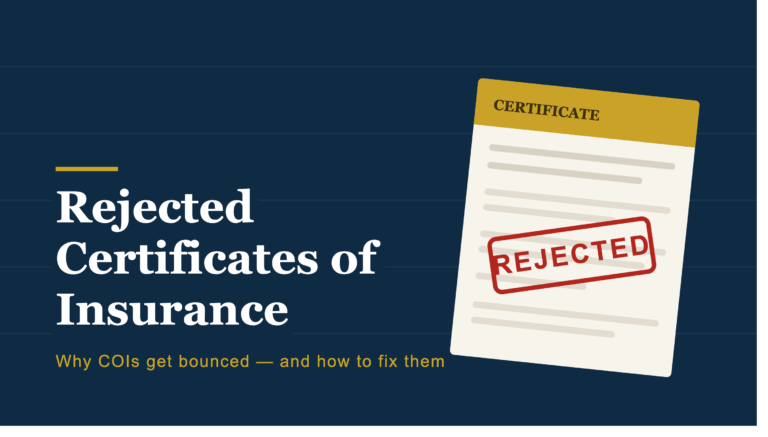
7. Accepting — or issuing — rejected and defective certificates of insurance
Here’s the pitfall that ties the whole ecosystem together, and the one most owners never think about until it bites: the certificate of insurance (COI).
Every time you hire a caterer, a security firm, a valet company, a live band, an entertainment contractor, or a maintenance vendor, you should be collecting a COI proving they carry their own coverage — and naming your business as an additional insured where appropriate. When you skip this, or accept a certificate that’s expired, has the wrong limits, or omits the additional-insured status you require, you inherit their risk. If their uninsured worker is injured on your property, or their negligence causes a loss, the claim can flow straight back to you.
The mirror image is just as costly. Your landlord, your event partners, and the venues you pop up in will demand COIs from you — and if yours is rejected because a limit is too low, an endorsement is missing, or the certificate holder is named incorrectly, you can lose the lease, the booking, or the partnership. Rejected COIs are a silent revenue killer in hospitality, and they almost always trace back to a policy that wasn’t structured to meet real-world contractual requirements.
Build a COI discipline: collect them before any vendor sets foot on site, verify limits and endorsements match your contracts, track expiration dates, and make sure your own policy is built to satisfy the certificates your partners will demand.
Why Atlanta makes all of this harder
These pitfalls exist everywhere, but several factors make metro Atlanta especially unforgiving.
The city’s nightlife density and late-operating venues concentrate exactly the A&B and liquor exposures carriers fear most. Georgia’s dram shop statute gives plaintiffs a clear path to venue liability. And the admitted market — the standard, state-regulated insurers — has been steadily pulling back from bars, clubs, and late-night hospitality, pushing this business into the surplus lines (excess & surplus, or E&S) market.
That shift isn’t inherently bad, but it changes the game. Surplus lines carriers offer the flexibility to actually cover A&B, assault, and hard-to-place liquor risks that admitted carriers won’t touch. The tradeoff is that these policies are more heavily endorsed, the exclusions are more consequential, and the coverage must be assembled deliberately rather than bought off a shelf. Working with a broker who lives in the surplus lines world — and who knows which carriers will write an Edgewood nightclub versus a Buckhead steakhouse — is the difference between a policy that responds and one that reveals a gap at the worst possible moment.
Your Atlanta hospitality insurance self-audit
Run through this checklist against your current policies. Every “no” or “not sure” is a conversation to have before your next renewal:
- Liquor liability is scheduled as its own coverage with a real limit — not assumed under general liability.
- Assault & battery is either covered with a meaningful limit or you understand exactly what you’re self-insuring.
- Property limits reflect current replacement cost, and you’ve checked your coinsurance clause.
- Business interruption limit matches trailing revenue, with an indemnity period long enough to survive a full rebuild.
- Workers’ compensation is in force for all employees including part-timers, with everyone classified correctly.
- Host liquor vs. full liquor — your coverage matches how your alcohol program actually operates today.
- Employment practices liability is in your program if you have more than a few employees.
- Certificates of insurance are collected from every vendor, verified against your contracts, and your own policy is built to satisfy the COIs your partners demand.
The bottom line
Insurance for Atlanta restaurants, bars, and clubs isn’t a commodity you buy once and forget. It’s a living program that has to match how your venue actually operates — the alcohol you serve, the crowds you draw, the staff you employ, and the partners you work with. The gaps in this playbook are the ones that don’t show up until a claim exposes them, and by then it’s too late to fix.
A policy that looks fine on the surface can still be riddled with the exclusions above. The only way to know is to have someone read the fine print who understands both the coverage forms and the realities of Georgia hospitality risk. And if you’re wondering what closing these gaps should actually cost, see our breakdown of what Atlanta bars, clubs, and hookah lounges pay for insurance in 2026.
B. Dixon Risk Management and Dixon Agency specialize in hard-to-place hospitality and surplus lines risk across Georgia and the Southeast — including the bars, clubs, and late-night venues that standard markets avoid. If you’d like a no-obligation review of your current program against the pitfalls above, reach out at bdixon@dixoninsure.com.



One Comment